The Gilded Roses of Royal Chelsea
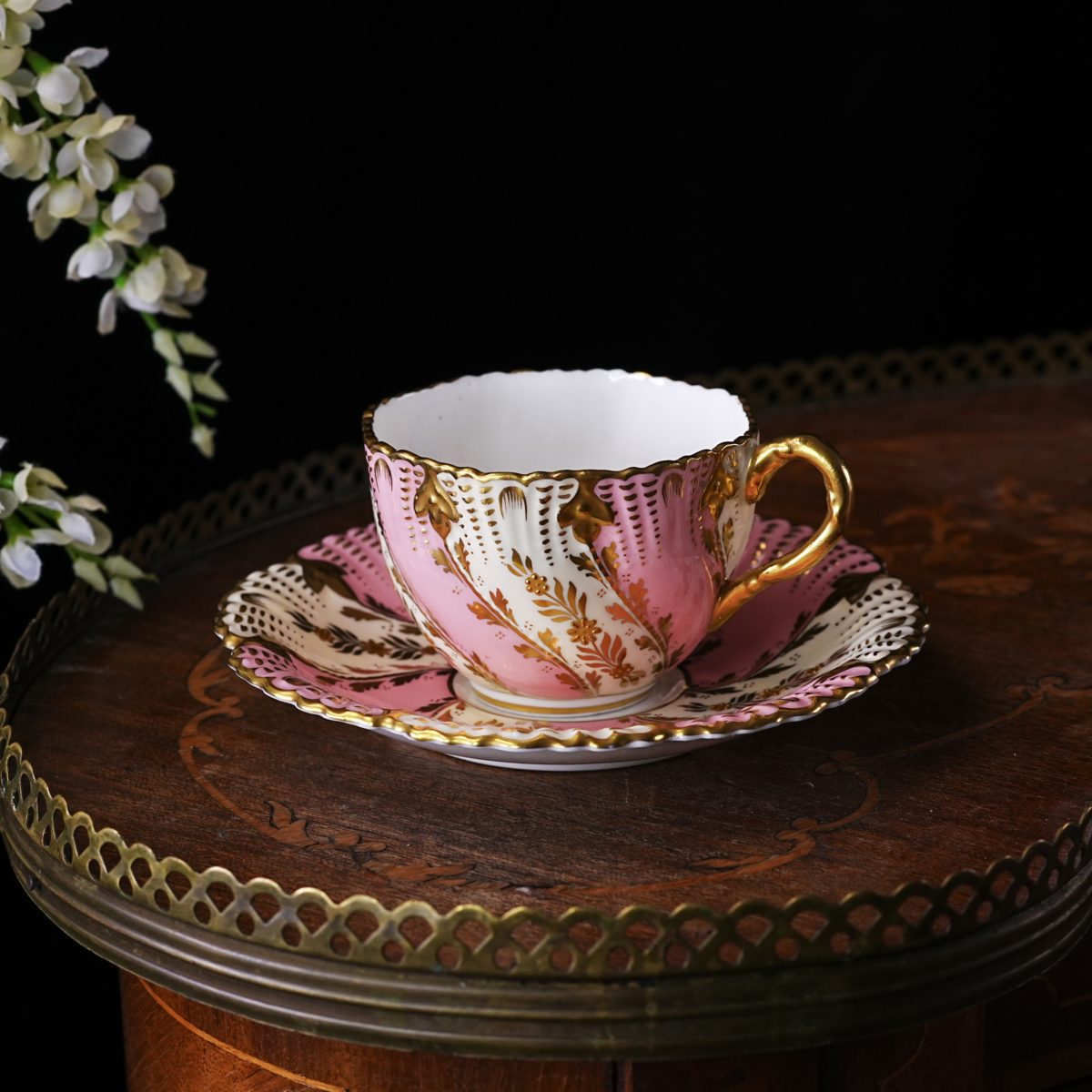
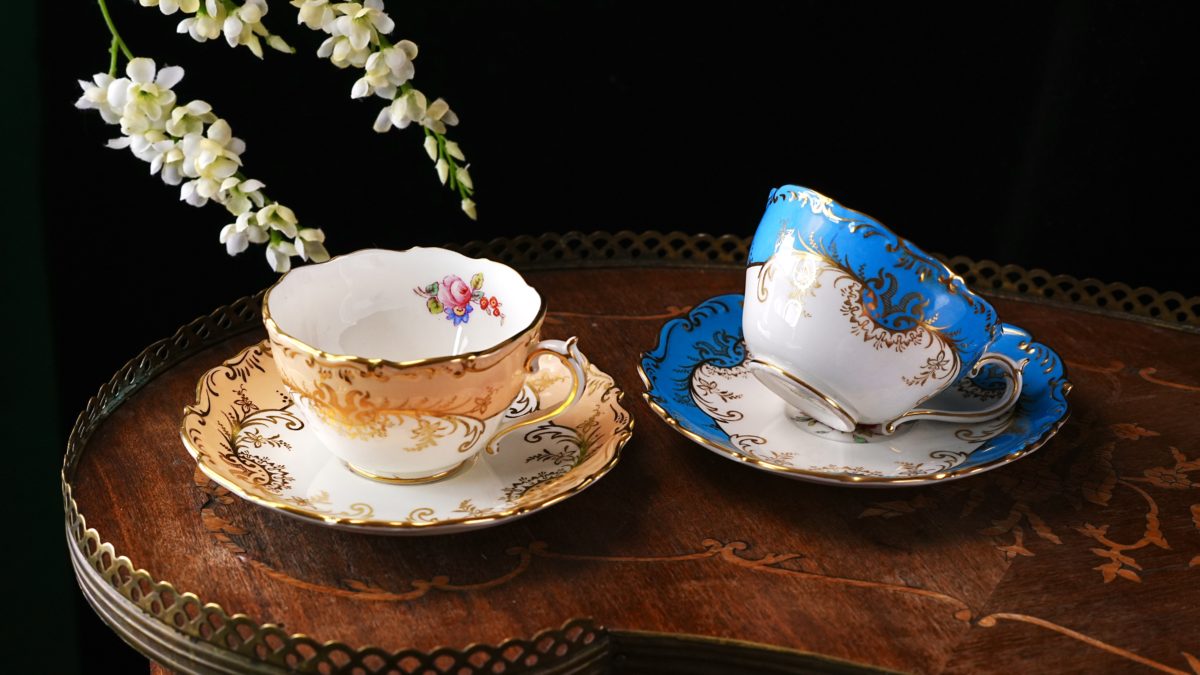
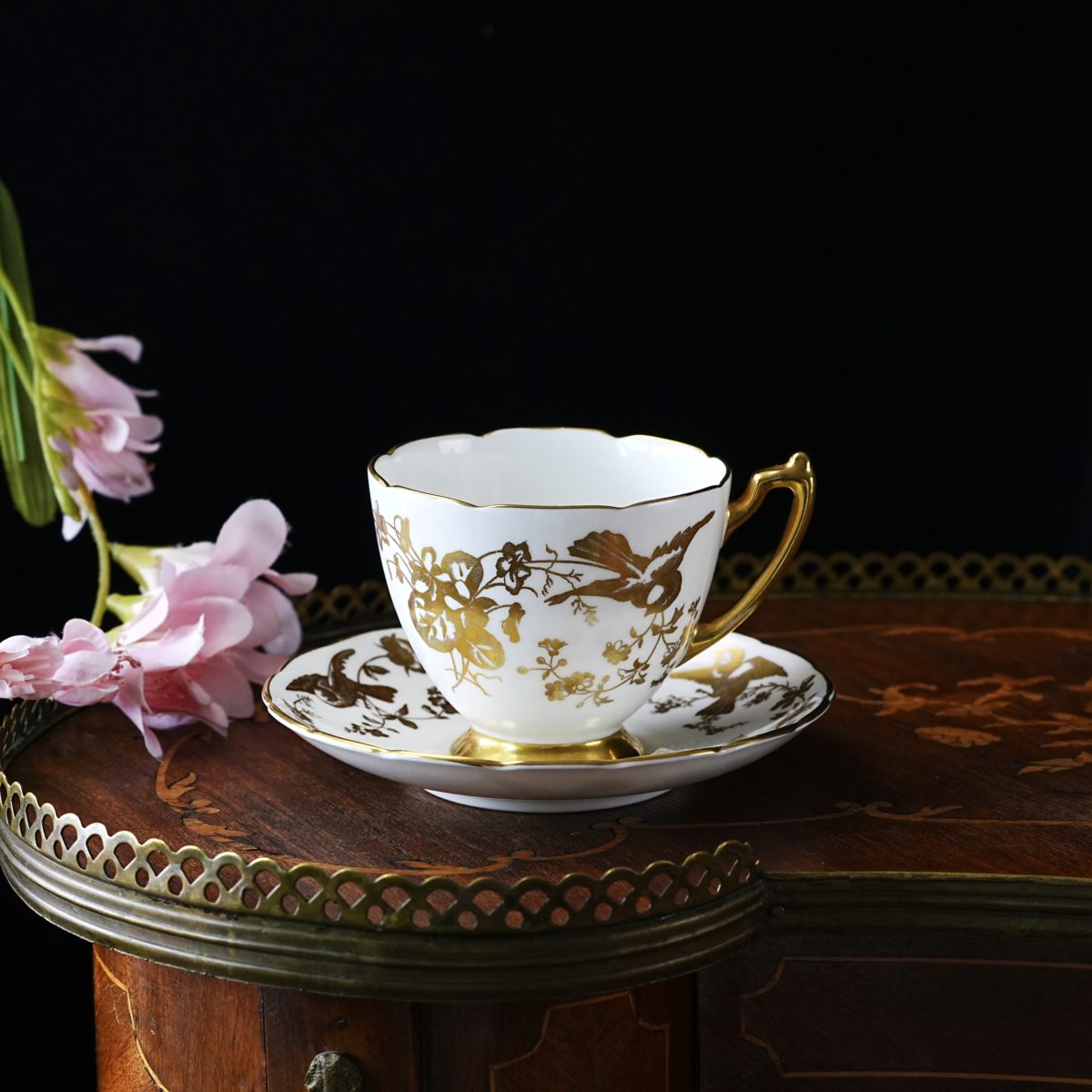
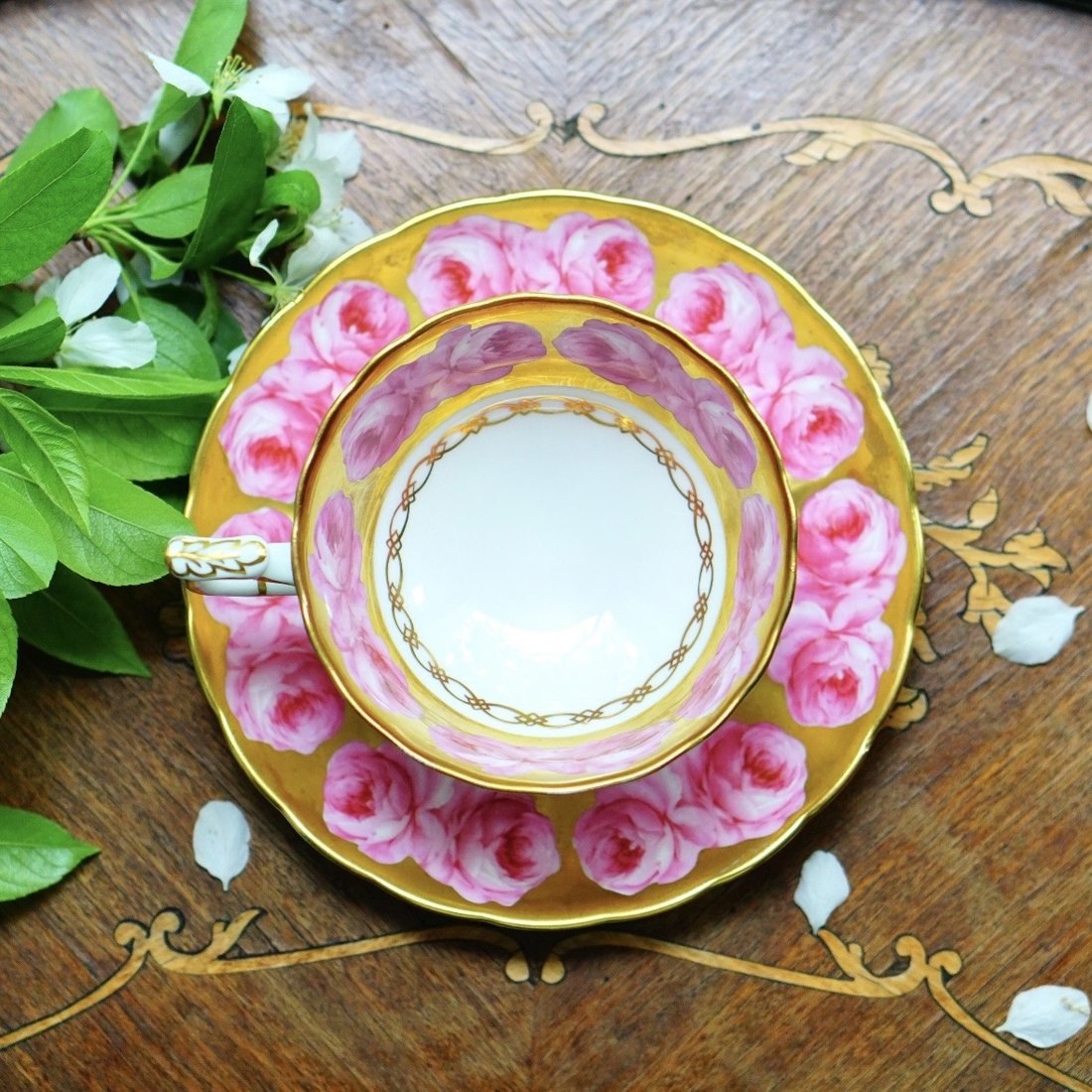
Pick up a piece of Royal Chelsea and the first thing you notice is the gold. Not a thin line at the rim, but whole vines and whole grounds of it — burnished until it gleams like jewellery, wrapped around roses that look freshly cut.
It is some of the most confident gilding in mid-century English china. But the regal name on the base hides a quieter, more tangled story — and once you know it, you can read the age of a cup almost from across the room.
The makers behind the anchor
Despite the name and the little anchor stamped on the foot, Royal Chelsea has no connection to the celebrated 18th-century Chelsea porcelain factory of London. The anchor is an homage — a borrowed echo of porcelain history, and a marketing habit common among the Staffordshire potteries of Longton, where this china was actually made.
The real story begins with the Plant family. Brothers R. H. & S. L. Plant were potting in Longton from around 1900, and by about 1912 the firm had taken the name New Chelsea Porcelain Co. Through the 1930s it shifted from harder porcelain toward fine bone china, and during the Second World War its production was folded into the family's larger Tuscan Works.
It was around 1943 that the “Royal Chelsea” trade name appeared, used chiefly on the prettier, heavily gilded tea wares aimed at the North American export market — which is exactly why so many of these pieces surface today in Canada and the United States rather than in Britain.
After that, the ownership changes come quickly. In September 1951 the New Chelsea business and its trade names were bought by Susie Cooper Pottery Ltd. Around 1961 the firm became tied to Grosvenor China (itself once Jackson & Gosling, founded 1866), and by the end of the 1960s the name had quietly disappeared. Royal Chelsea bone china, then, had a working life of barely two decades — roughly 1943 to the early 1960s.
A house built on gold and roses
Royal Chelsea never marketed named “collections” the way Royal Albert did with its Old Country Roses. There is no official gilded-rose series to tick off against a checklist. What there is instead is a recognisable house style — and once you have seen a few pieces, you can spot it on a crowded shelf.
That style rests on two things, applied with more generosity than the modest price suggests: roses and gold. Pink cabbage roses, often massed into an all-over chintz; trailing gold-leaf vines; and, on the better pieces, hand-applied enamel dots raised just enough to catch under a fingertip. Handles, rims and foot-rings are frequently drowned in gilt.
This is not token gilding, but gold laid on thickly enough to read as ornament in its own right.
It is the gold that does the talking. Where many Longton makers used a fine gilt line as a finishing touch, Royal Chelsea treated it as the decoration — burnished, lustrous, and covering large areas of the surface. That generosity is part of why its heavily gilt pieces still hold a steady, affectionate following among collectors.
The rose, two centuries in the making
Royal Chelsea did not invent its roses; almost no one in English china did. They are, in the end, all descendants of one man's brush. William Billingsley (1758–1828) was the most admired flower painter of his age — apprenticed at Derby in 1774, where his rose-bordered “Prentice Plate” became the very standard against which trainees were judged. He painted the rose in every mood, and with a trick of his own: he would load the brush with colour, then lift most of it away again with a second, almost dry brush, so each petal seemed lit from within. Collectors still call it the “wiping-out” technique, and it is why a Billingsley rose looks less painted than grown.
Billingsley was restless. He left Derby in 1796, refined porcelain at Worcester, gambled everything on his own soft-paste recipe at Nantgarw in Wales, and finally came to rest at Coalport, where he worked until his death in 1828. By then his way with a rose had become the house style of an entire industry. Spode, more than anyone, turned it into a repeatable pattern — full pink blooms in a cage of gold, the “cabbage roses” collectors prize — and Coalport, Davenport and H. & R. Daniel all produced their own versions, the painters carrying the design from one factory bench to the next.
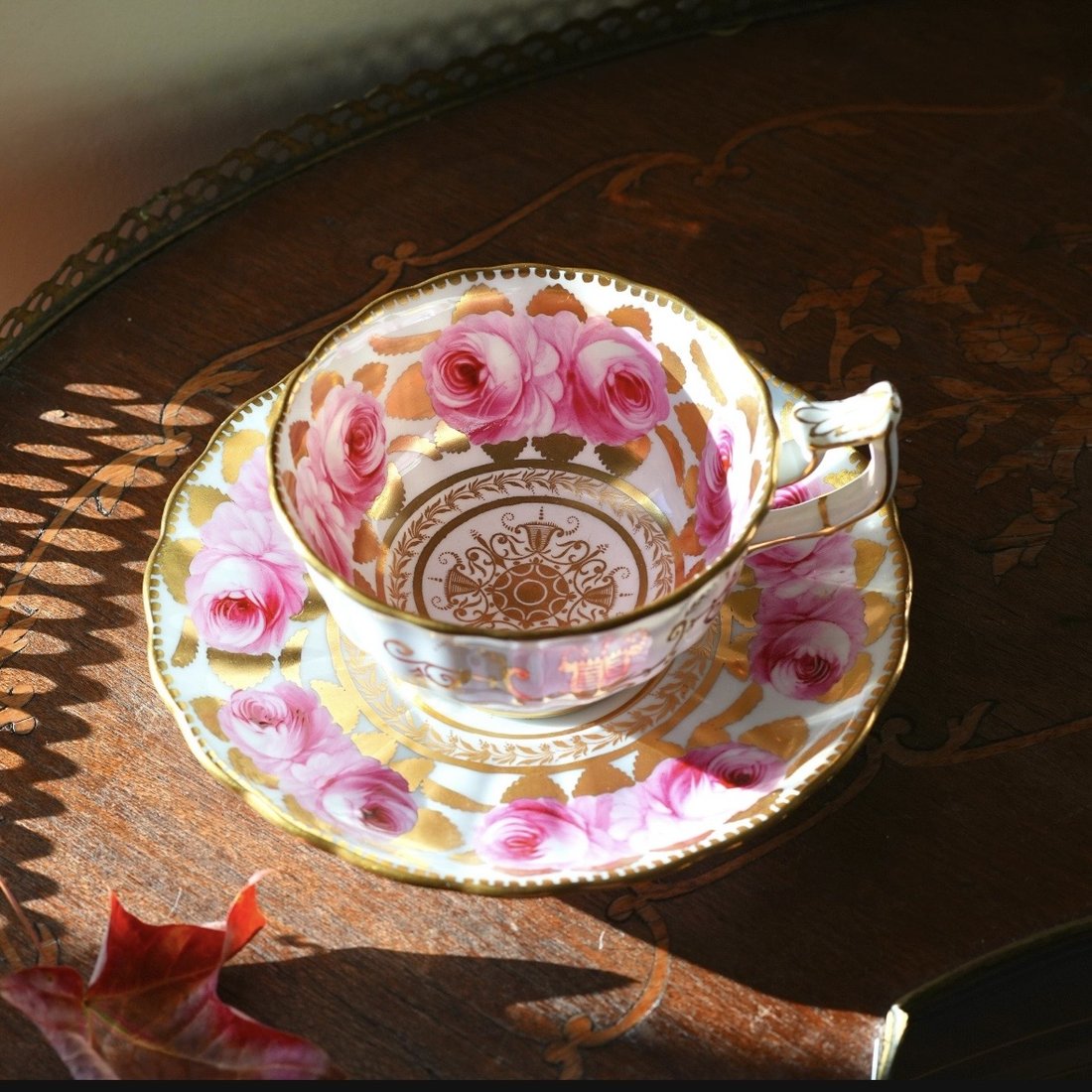
This is exactly where a piece like our (now sold) 1820s–30s Coalport cup belongs: hand-painted cabbage roses under heavy raised gilt, made at the very works where Billingsley ended his days. It is the genuine Regency article — the rose at full hand-painted strength.
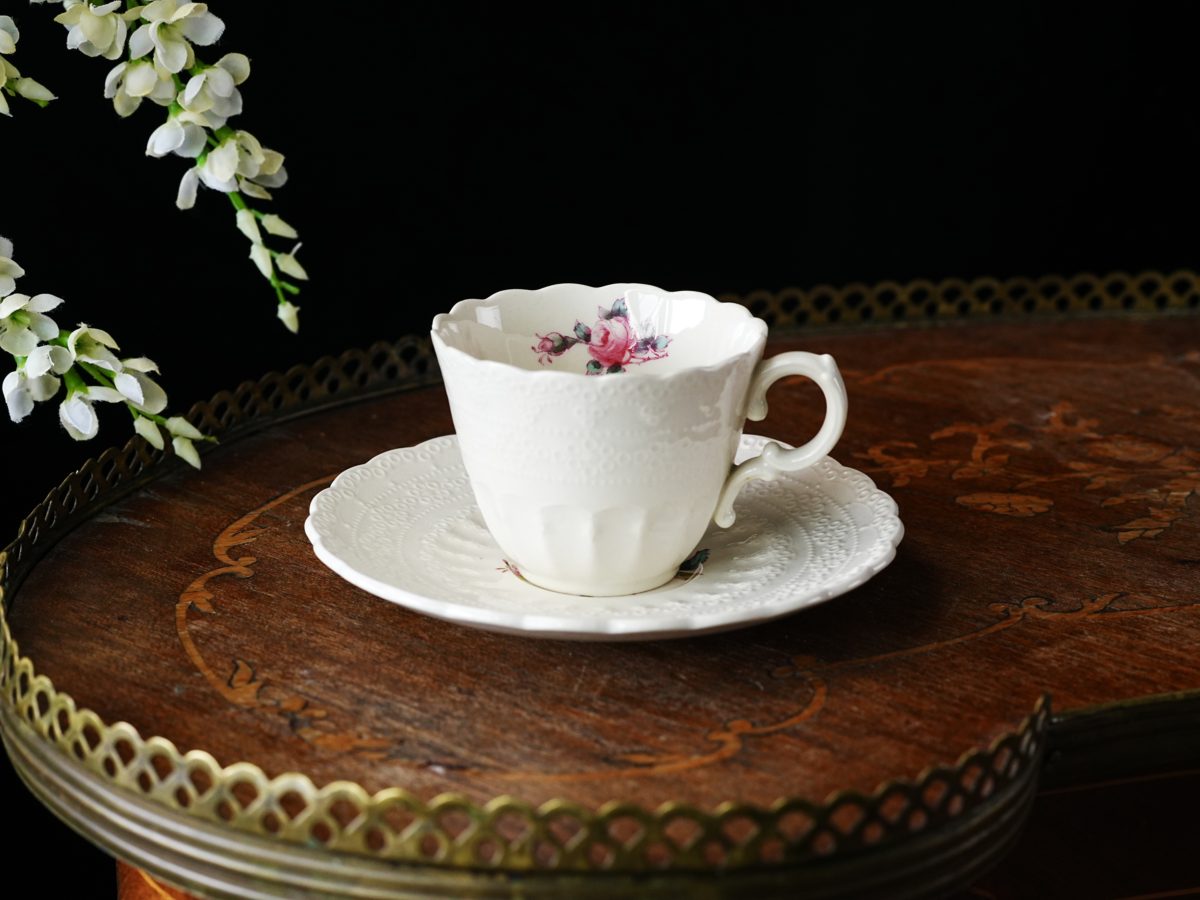
Then the century turned, and so did the technology. After the Second World War the English potteries mechanised; transfer printing replaced the loaded brush, costs fell, and bone china stopped being a luxury for the few. The cabbage rose survived the change — it was simply printed now rather than painted — and among the firms that kept it alive for the new middle-class and North American market were Copeland (Spode's own successor) and our friend Royal Chelsea. Look closely at a Royal Chelsea rose and you can read the whole story in it: the faint grain of the transfer, the absence of brushstrokes. The romance is Billingsley's; the execution belongs to the machine age.
The two firms even shared a fondness for borrowed prestige. Coalport stamped some wares “A.D. 1750,” though John Rose only founded it in 1795; Royal Chelsea borrowed the anchor and the name of the celebrated eighteenth-century Chelsea factory it had no connection to. Both were reaching back for a little inherited grandeur — and both, to be fair, earned some of it with the sheer quality of their gold.
Reading the evolution in a single cup
Because Royal Chelsea left us pattern numbers rather than pattern names, dating a piece is a small detective exercise. A few reliable clues:
- The wording of the mark. Earlier pieces often read simply “Royal Chelsea / England,” while later ones add “Bone China” and “Made in England” — a rough signal of a later, 1950s-or-after date.
- The anchor and the handwriting. The anchor backstamp usually sits above a hand-painted pattern number in red — 3483 A for a gold-leaf vine, say, or 4330 A for a pink-rose chintz. That number, not a name, is how collectors tell one decoration from another.
- Body and gilding. The move from porcelain to bone china, and the heaviest, most burnished gilding, both tend to belong to the export-era Royal Chelsea of the 1940s and 50s.
Put those together and a single cup can place itself fairly confidently within the company's short life.
From our collection
We currently have three Royal Chelsea pieces that, between them, sketch the house style nicely: a gold-leaf vine creamer (3483 A) dense with burnished gilding; a pink-rose chintz cup with an unusual black handle and rims (4330 A); and a striking gold-and-turquoise geometric petal cup that shows the firm reaching beyond roses toward something almost Art Deco.
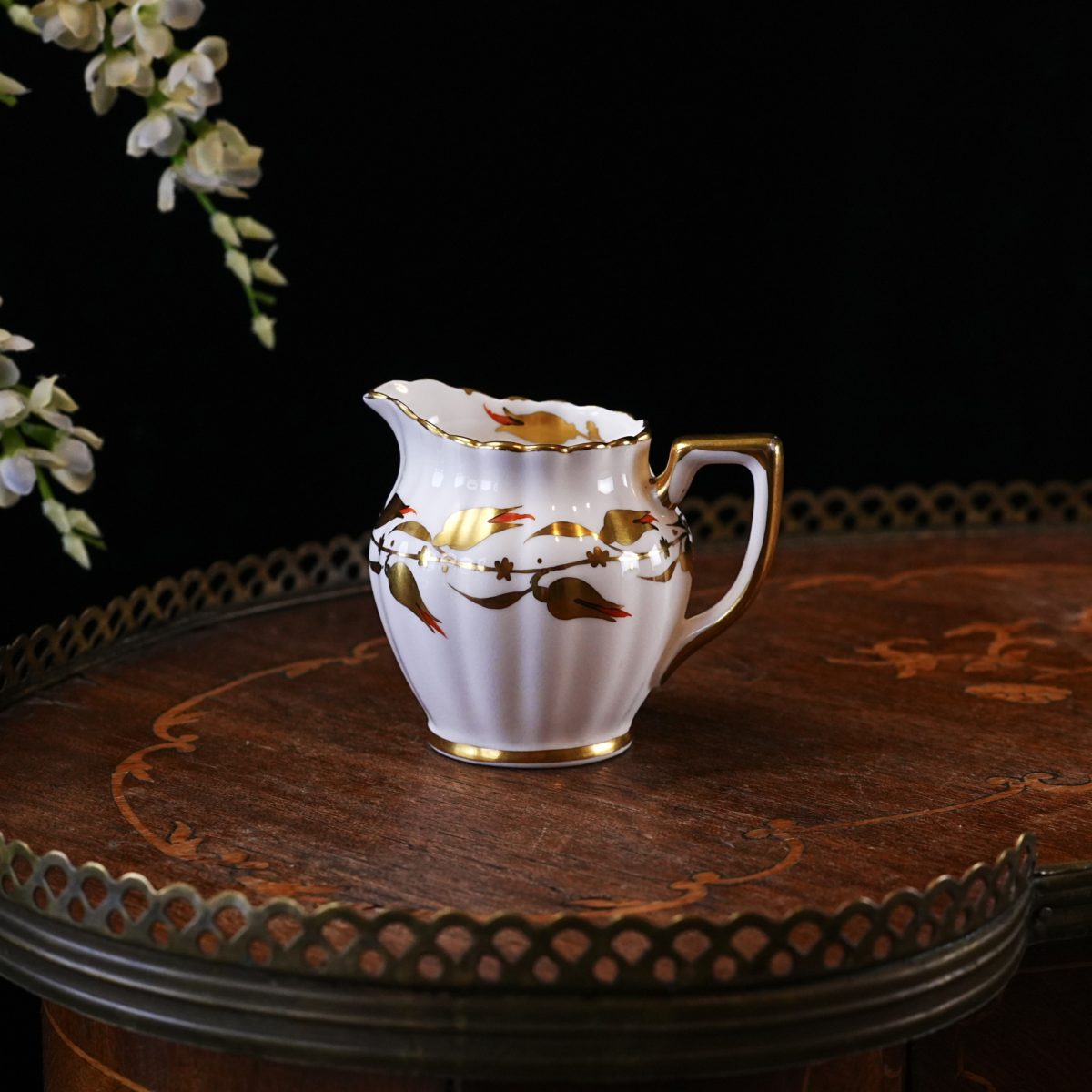
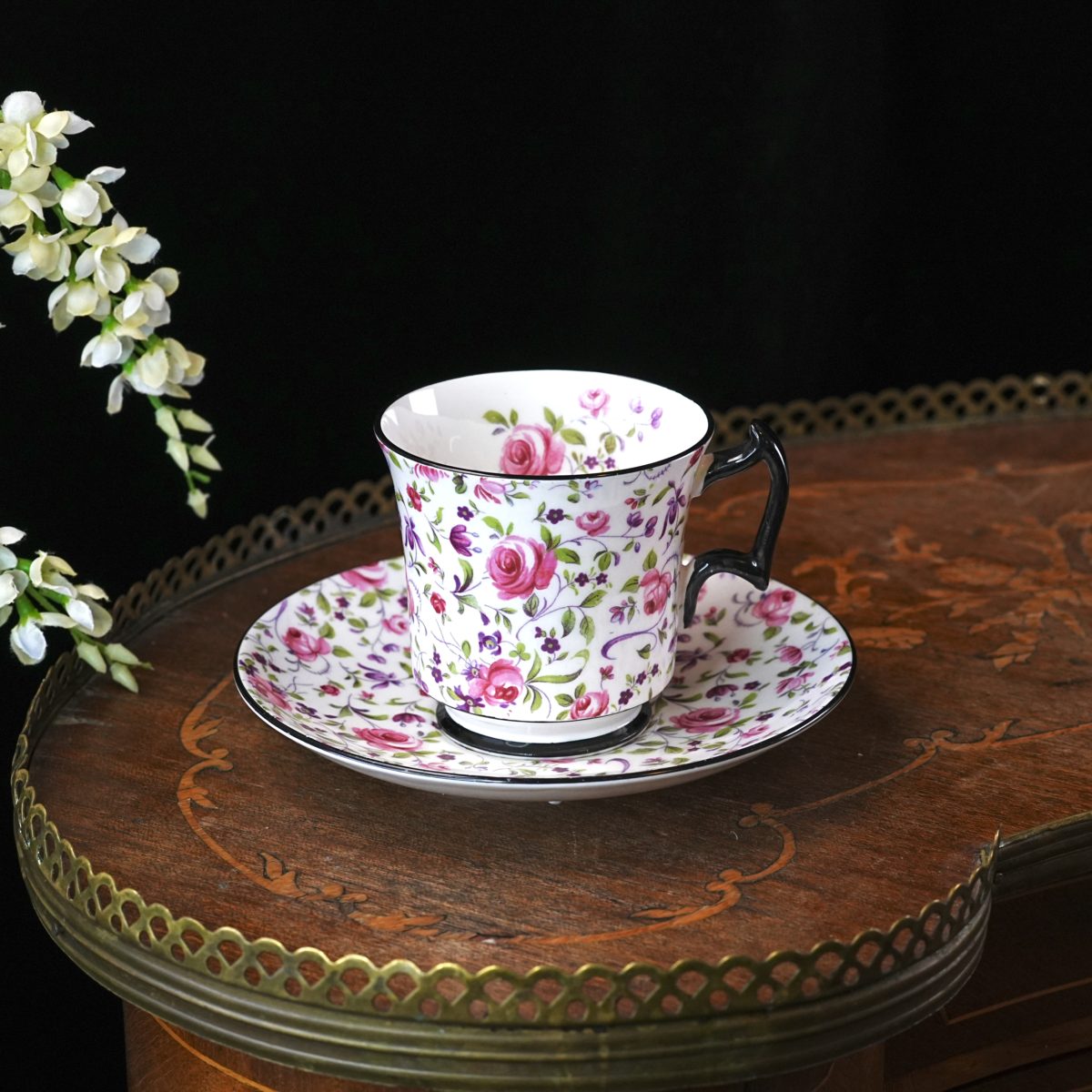
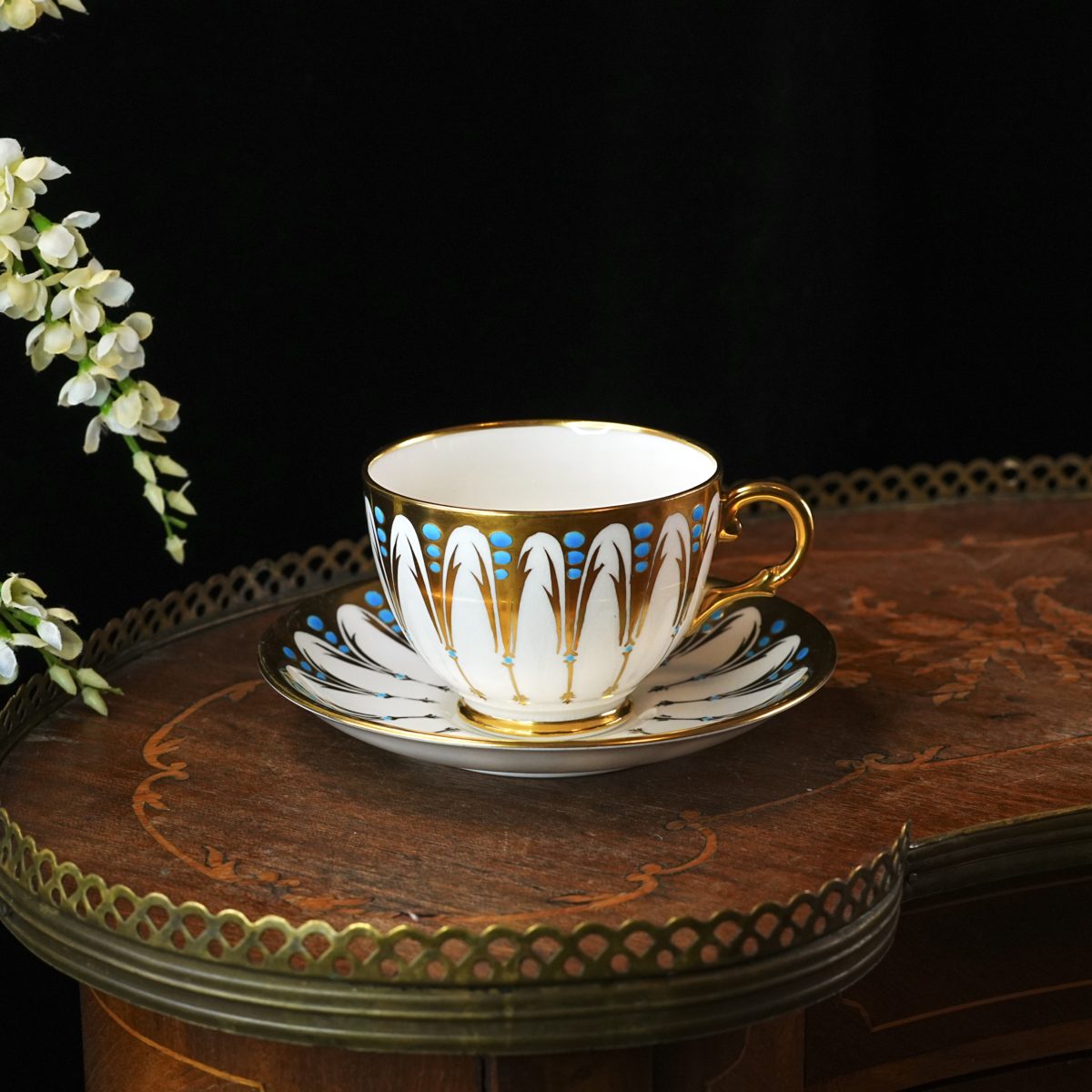
Seen side by side, they are a small lesson in how a short-lived maker kept circling back to the same idea — gold, generously given — and dressing it in whatever the decade happened to favour.
Drawn to the gleam of old gold? Browse the full collection, or get in touch about a piece.
Browse the collectionSources: New Chelsea / Royal Chelsea history from Pottery Histories and The Potteries; Coalport and John Rose from Wikipedia and Britannica; William Billingsley and the cabbage-rose lineage from Wikipedia and the Nantgarw China Works Museum; pattern, backstamp and decoration details recorded from pieces in our own collection.