The mark on the base is half the story. Here is how we read and date the makers that pass most often through the shop — and how you can, too.
Turn almost any piece of antique china over and it will try to tell you who made it and roughly when. Before chasing a single maker, four clues are worth reading on every base.
01
The country wording
A bare “England” (or no country at all) tends to be earlier; “Made in England” became common from about 1900–1910; and “Bone China” as a printed phrase is largely a 20th-century habit. The American McKinley Tariff Act of 1891 required imports to name their country of origin in English — which is why so much English and European china of this era is marked at all.
02
Printed vs. impressed
A mark pressed into the clay is usually a factory or body mark; a printed (transfer) mark carries the decoration and pattern detail. Many pieces have both, and reading them together tells you more than either alone.
03
Registration marks
A diamond-shaped “Rd” device dates a design to 1842–1883; “Rd No.” followed by a number is 1884 onward, and the number itself roughly dates when the design was registered.
04
Pattern & shape numbers
Hand-painted or printed numbers identify the decoration and shape, not the year — but they let you match, attribute and place a piece with confidence.
One warning: marks were freely borrowed, and grand “antique” dates were sometimes invented for prestige — Coalport's “A.D. 1750” and Royal Chelsea's little anchor are the classic examples. Read the whole mark, not one flourish.
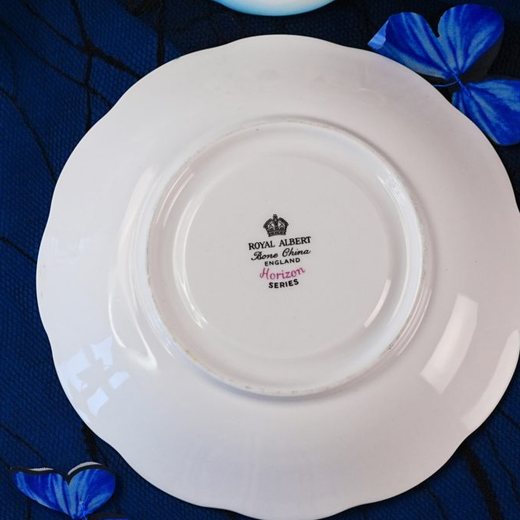
Crown over “Royal Albert”, usually with “Bone China” / “England”An actual Royal Albert crown mark from the shop
Royal Albert grew out of Thomas C. Wild & Sons of Longton, who named their Albert Works for the prince consort. The crowned “Royal Albert Crown China” marks belong to the earlier 20th century; the familiar crown over “Royal Albert / Bone China / England” is the long-running mid-century mark.
A named pattern in the mark (most famously Old Country Roses, introduced 1962) signals a later, post-war piece.
“Made in England” and “Bone China” together point to mid-century or after; an earlier “Crown China” wording points to the 1920s–30s.
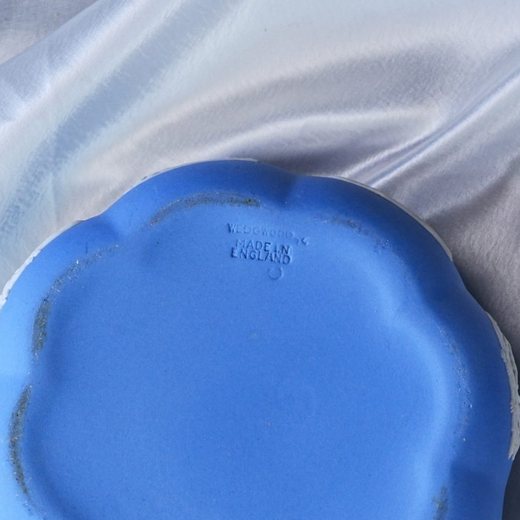
Impressed or printed “WEDGWOOD” (one word, no apostrophe)An impressed WEDGWOOD mark from the shop
Founded by Josiah Wedgwood in 1759 and still trading, Wedgwood is one of the most marked names in ceramics. The plain impressed WEDGWOOD is the body mark; printed marks add the pattern and, often, the country wording.
Spelled WEDGWOOD — not “Wedgwood & Co.” or “Wedgwood & Sons”, which are different, unrelated Staffordshire firms.
“Made in England” and “Bone China” indicate a 20th-century piece; 19th-century wares often carry impressed three-letter date codes.
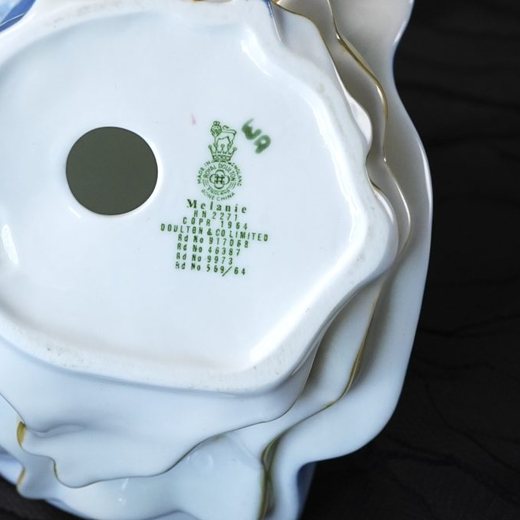
Lion on a crown, over “Royal Doulton” — with HN numbers on figuresA Royal Doulton lion-and-crown mark with its HN number
Doulton received its royal warrant in 1901 and the lion-and-crown mark followed. For collectors, the great gift is the HN number on figurines — a sequential catalogue begun in 1913 and named for the colourist Harry Nixon.
Because HN numbers were issued roughly in order, the number dates a model's introduction — a low HN is early, a high HN later.
“Made in England” and “Bone China”, plus pattern or series names, place tableware in the mid-to-late 20th century.
Ay
Aynsley
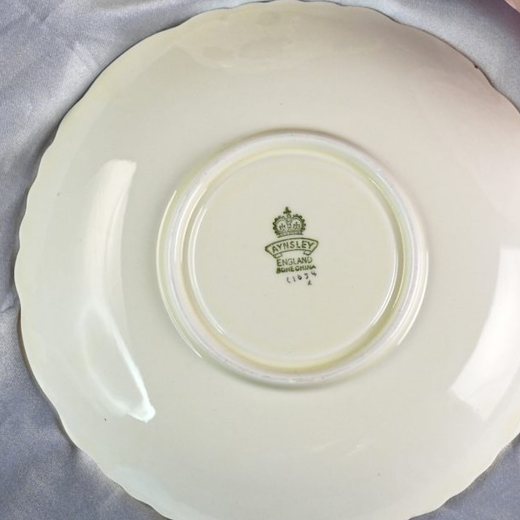
Crown-and-banner mark; later marks add “Est 1775”An Aynsley crown mark from the shop
John Aynsley & Sons of Longton (established 1775) made some of England's most painterly bone china. The printed crown-and-banner mark is the constant; the details around it carry the date clues.
Marks adding “Est 1775” or “Fine English Bone China” are later 20th-century forms.
Hand-painted, artist-signed cabinet pieces (fruit, orchids, gilt) are an Aynsley speciality; the shape and pattern numbers help match and place them.
The firm of Wileman & Co. traded as “Foley” and “Late Foley” before adopting the family name. The famous script “Shelley” in a shield dates from about 1925 onward.
A script-Shelley mark = post-1925; earlier pieces read “Foley” or “Late Foley.”
Registered shape names — Dainty, Queen Anne, Regent, Vincent — and pattern numbers help identify the form and decoration.
Co
Coalport
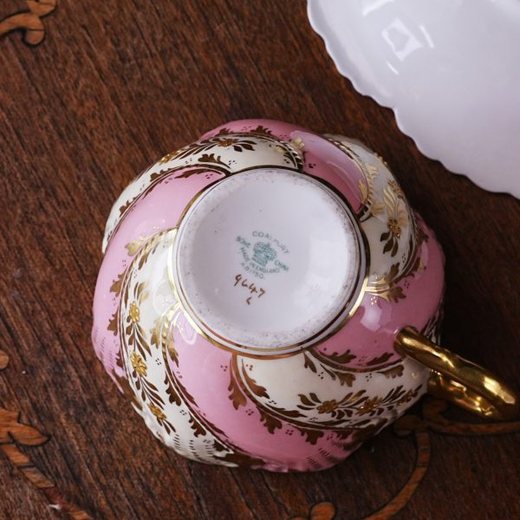
Crowned mark with “Coalport” and the decorative “A.D. 1750”A Coalport crown mark from the shop
Coalport was founded by John Rose in Shropshire around 1795. The crowned “Coalport A.D. 1750” mark is a piece of marketing romance — the “1750” is not a date of manufacture, but a nod to an earlier local pottery.
Ignore “A.D. 1750” for dating; read the wording instead — “Bone China” and “Made in England” place a piece in the 20th century.
Coalport is prized for jewelled gilding — raised, individually applied gold dots — and for richly gilt cabinet cups.
Pa
Paragon
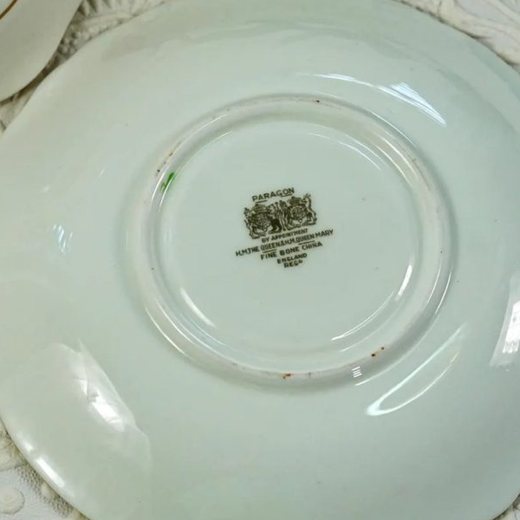
Star device, often with a royal warrant inscriptionA Paragon double-warrant mark from the shop
Paragon (from the earlier Star China Co. of Longton) built its reputation on royal commissions, and its marks wear that history openly.
The warrant wording runs in three generations, and reading it narrows a Paragon piece to within about a decade. An unnamed “By Appointment” under the Royal Arms follows the firm's first warrant in 1933; the double warrant naming both “H.M. The Queen” and “H.M. Queen Mary” runs from about 1939 to 1949; a single named warrant to Her Majesty the Queen belongs after 1952.
“Fine China” is the earlier wording; “Fine Bone China” is later. And the word Paragon itself is a date clue — the firm traded as the Star China Company until 1930.
Patterns are often named (e.g., commemorative and “bride” pieces) and finished with generous gilt.
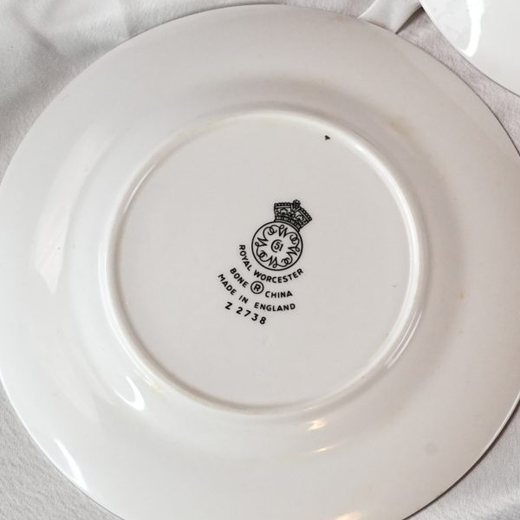
Crowned roundel with interlaced “W”; dot-and-mark date systemA Royal Worcester crowned mark from the shop
One of England's oldest porcelain names, Royal Worcester (in its modern form from 1862) ran one of the most precise dating systems in the trade.
From 1892 a dot was added beside the mark for each year, so that by 1915 there were twenty-four of them crowded round the crown. In 1916 the count was reset with a star, and a dot added annually thereafter: star alone is 1916, star and two dots 1918, star and six dots 1922, and so on to eleven dots in 1927.
A glance sorts the two eras: a dense ring of dots means the early 1910s, a star means 1916 or later. The puce printed mark itself was in use from 1900 to 1941.
“Bone China” / “Made in England” wording and pattern names support the dot-code date.
Gr
Grainger (Royal China Works, Worcester)
Green circular mark: “Royal China Works” round a shield reading “G & Co / Established 1801”, over “Worcester / England”
Worcester's other factory. Thomas Grainger, who had trained at Chamberlain's, set up in rivalry in 1801 and the firm competed across the same small city for most of a century. Royal Worcester bought it in 1889 but let the Grainger name trade on until the works closed for good in 1902.
A single letter beneath ENGLAND is the year, and the sequence is short and complete: A = 1891 through to L = 1902, one letter per year, nothing skipped. Every lettered Grainger piece therefore comes from a twelve-year window — a naturally closed set.
Through the 1890s Grainger specialised in hand-painted display pieces and blush ivory, a tinted ground shading from cream to apricot laid over the finished glaze and fired again. Good blush ivory shows no line anywhere in the transition.
Small coloured dots on the base — a red spot, a blue stroke — are workmen's or paintress's marks, not dates or pattern numbers.
When the works shut in 1902 the painters crossed the city to Royal Worcester, the Stinton family among them — which is why the two factories' bird and cattle painting can look so closely related.
Wi
Royal Winton (Grimwades)
“Royal Winton” over “Grimwades / England”
Grimwades Ltd of Stoke adopted the “Royal Winton” name in 1929 and became the great name in chintz — all-over printed floral tableware.
Chintz patterns are named (Summertime, Hazel, Julia, and many more); the pattern name plus the mark wording places most pieces in the 1930s–50s.
Well-matched chintz, with the print running cleanly over handles and rims, is a sign of quality.
RC
Royal Chelsea
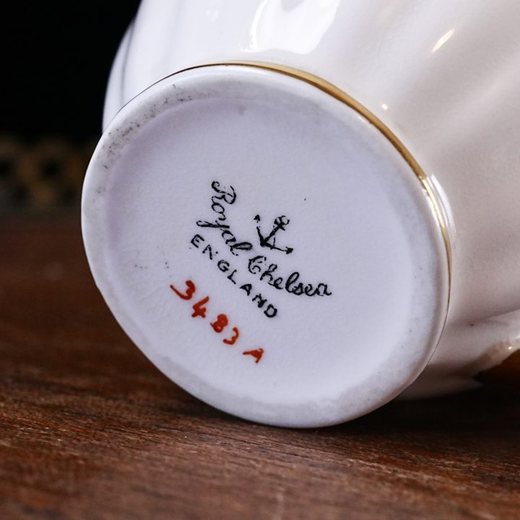
A small anchor — an homage, not the 18th-century Chelsea factoryThe little Royal Chelsea anchor from the shop
Despite the regal name and the little anchor, Royal Chelsea has no link to the celebrated 18th-century Chelsea works. It was made by the Plant family's New Chelsea Porcelain Co. of Longton, roughly 1943 to the early 1960s, chiefly for the North American export market.
The decoration is identified by pattern numbers (such as 4947 A), not names.
The heaviest, most burnished gilding belongs to the export era of the 1940s–50s. We tell the fuller story in our Royal Chelsea journal.
Go
W. H. Goss
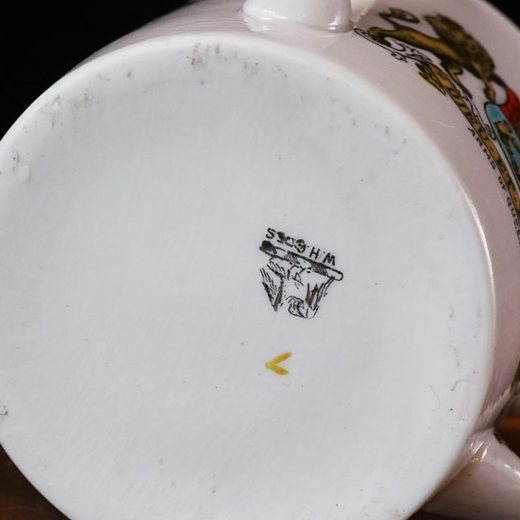
Goshawk crest over “W. H. Goss”A W. H. Goss goshawk crest from the shop
William Henry Goss of Stoke is best known for finely potted heraldic and crested “Goss china” — small souvenir pieces carrying town and family arms, hugely popular from the late 19th century into the 1930s.
The printed goshawk crest with “W. H. Goss / England” is the maker's mark; the applied coat of arms identifies the place or family, not the date.
Early Goss is thinly potted, ivory-toned parian; later, mass-market pieces are heavier.
Ro
Rosina — Queen Anne & Queens
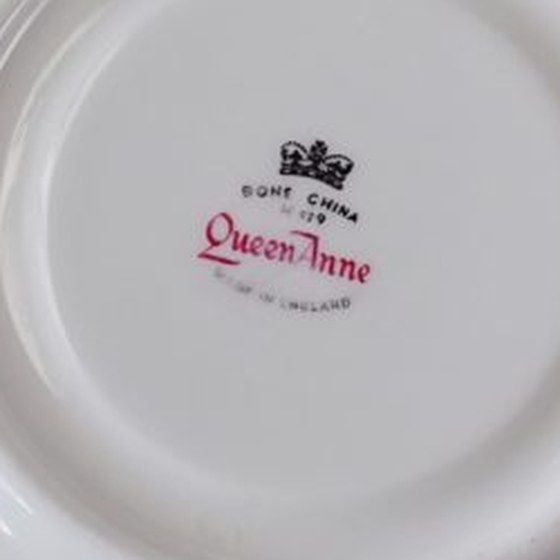
A small crown over a colour script name — “Queen Anne” or “Queens”A Queen Anne (Rosina) crown mark from the shop
The Rosina China Co. of Longton sold its bone china under the trade names Queen Anne and Queens. The mark pairs a small printed crown with the range name in colour script.
“Bone China” and “Made in England” with a crown and a script name point to the mid-20th century.
A letter-plus-number by the mark (e.g. C979) is a pattern number, not a date.
RS
Royal Standard
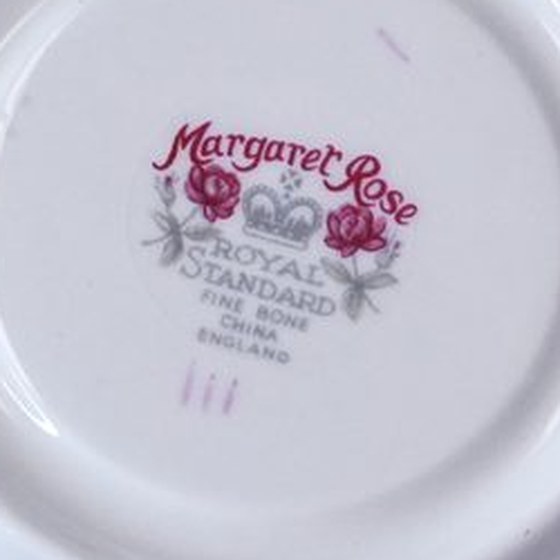
A crown flanked by roses — “Royal Standard / Fine Bone China / England”A Royal Standard crown-and-roses mark from the shop
Royal Standard, a Longton bone-china name, used a pretty crown-and-roses mark with the pattern name in red script above.
“Royal Standard / Fine Bone China / England” points to the mid-20th century.
The red script above the crown (e.g. Margaret Rose) is the pattern name.
RC
Royal Cauldon
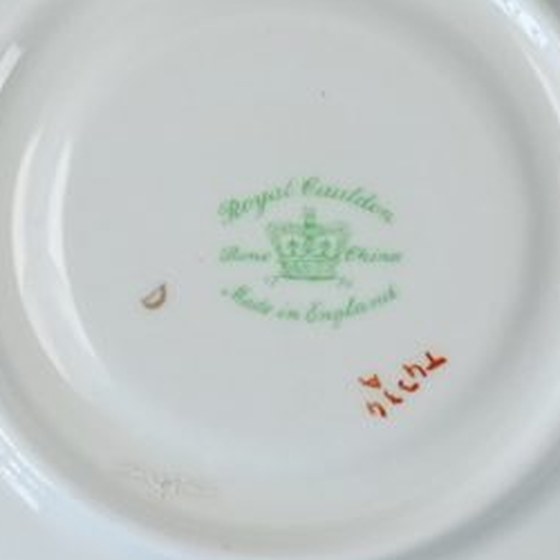
A crown over “Royal Cauldon” in script, with “Bone China / England”A Royal Cauldon crown-and-script mark from the shop
Royal Cauldon descends from the old Cauldon Potteries at Stoke, a name with 18th-century roots. The green crown-and-script mark is its mid-20th-century bone china form.
“Royal Cauldon / Bone China / Made in England” with a crown points to the mid-20th century.
A hand-inked number by the mark is a pattern number.
Tu
Tuscan & Royal Tuscan
A crown over “Tuscan” / “Royal Tuscan” — “Fine English Bone China”
Tuscan China (R.H. & S.L. Plant of Longton) traded as Tuscan and later Royal Tuscan. Its marks pair a crown with the Tuscan name and a pattern number.
“Royal Tuscan” (rather than plain “Tuscan”) points to the later, mid-20th-century mark.
A pattern “D-number” (e.g. D2962) is a pattern code, not a date.
SR
Samuel Radford
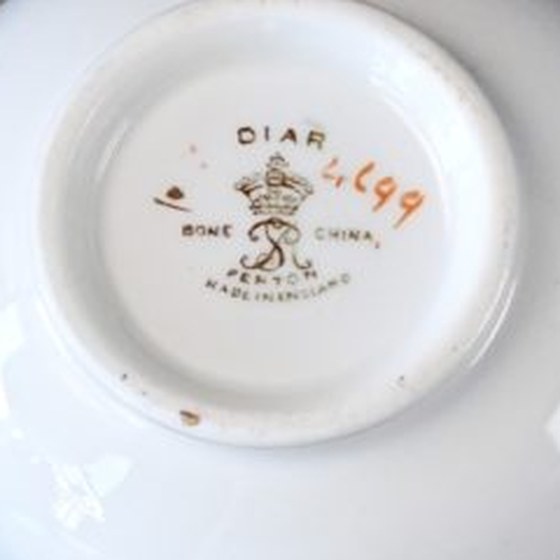
A crown over an “SR” monogram — “Bone China / Fenton”A crowned Samuel Radford (SR) mark from the shop
Samuel Radford of Fenton made fine bone china from the 1880s. The crown-over-SR mark, with “Fenton” and often a pattern name, is the 20th-century form.
“Bone China / Made in England” with the crowned SR points to the earlier-to-mid 20th century.
The word by the mark (e.g. Diar) is a pattern name; the gilt number is its pattern number.
Mi
Minton
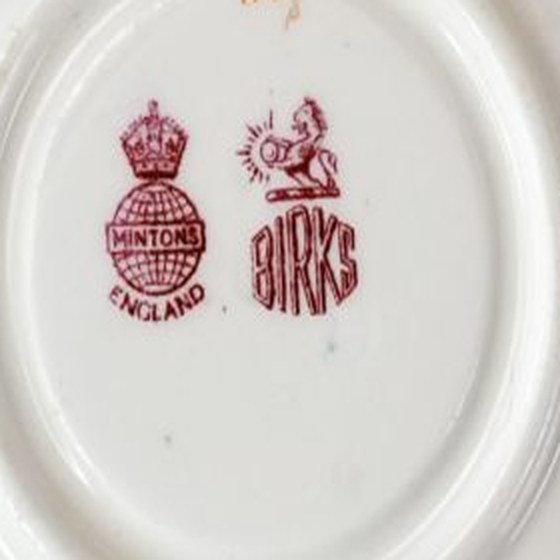
A crowned globe — “MINTONS” / “MINTON” over “England”A Minton crowned globe with a retailer's (Birks) mark
Minton of Stoke used a crowned globe mark from the late 19th century. Fine Minton was often retailed by luxury shops, whose own marks (here the Canadian jeweller Birks) sit beside it.
“MINTONS” with an S is pre-1951; the S was dropped to “MINTON” after.
A second mark (a retailer such as Birks) is the seller, not the maker.
CS
Copeland & Spode
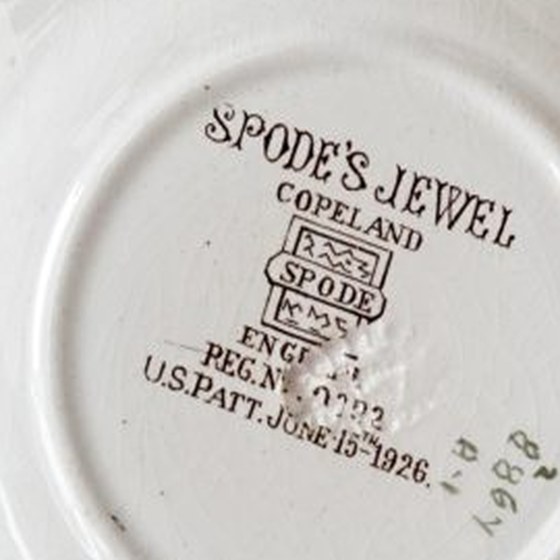
“Copeland Spode” with the Spode tower and a “Reg. No.”A Copeland Spode mark with its registration number
The Spode works at Stoke traded as W.T. Copeland through the 19th and early 20th centuries; “Copeland Spode” marks bridge that period before the name reverted to Spode.
“Copeland Spode / England” places a piece roughly 1890s–1960s.
A “Reg. No.” and a “U.S. Patent” date (here 1926) can be traced to a year.
Ri
Ridgway
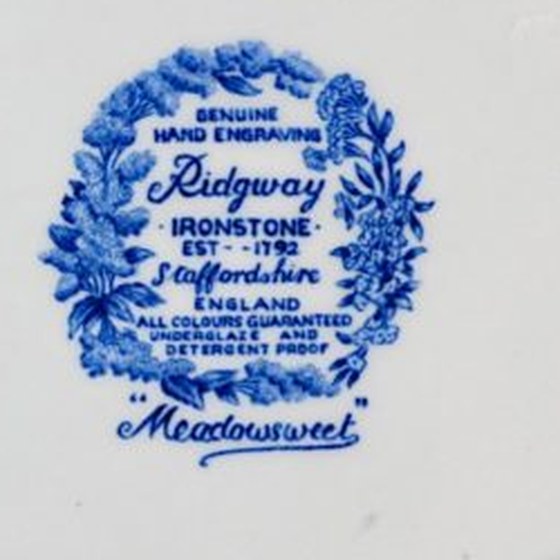
A printed wreath — “Ridgway / Ironstone / Est. 1792”A Ridgway ironstone wreath mark from the shop
The Ridgway name at Shelton goes back to 1792. On mid-century transferware the mark is a printed wreath with the pattern name and “detergent-proof” reassurances.
“Est. 1792” is a heritage date, not the date of the piece.
“All colours guaranteed underglaze… detergent proof” wording is a 1950s–60s tell.
WS
Wood & Sons
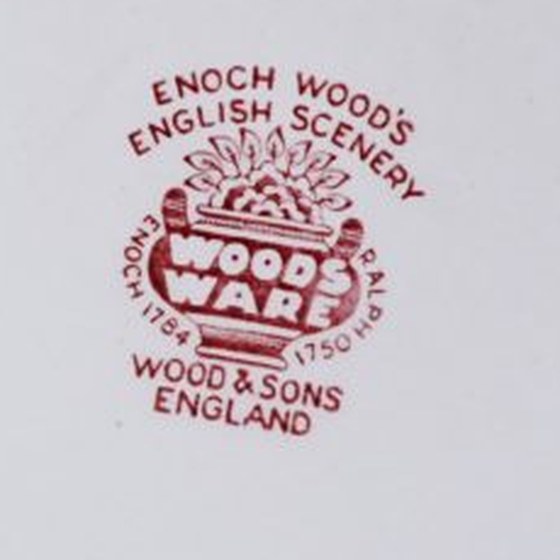
A basket/urn device — “Enoch Wood's English Scenery / Wood & Sons”A Wood & Sons “English Scenery” mark from the shop
Wood & Sons of Burslem carry the heritage of Enoch Wood (1784) and Ralph Wood (1750). Their popular “English Scenery” transferware wears both founders' dates in the mark.
“1750” and “1784” in the mark are the founders' dates, not the piece's.
“Wood & Sons / England” with a printed pattern name points to the 20th century.
Wa
Wade
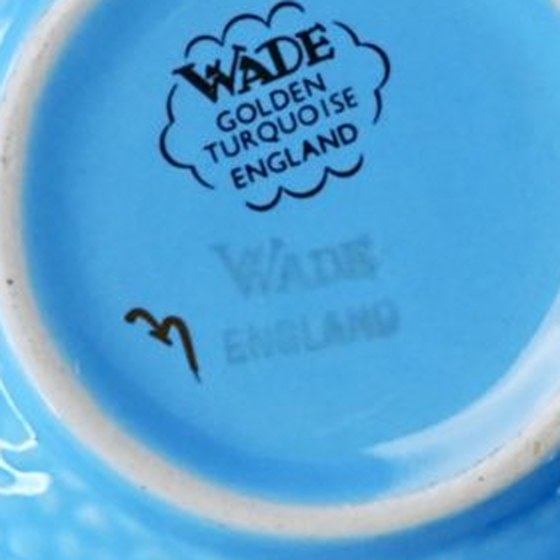
“Wade / England” — often a named glaze range in a cloud cartoucheA Wade “Golden Turquoise” mark from the shop
Wade of Burslem is best known for small earthenware and figures. On decorative ware the mark names the glaze range (here “Golden Turquoise”) in a scalloped cartouche.
“Wade / England” with a named colour range points to the mid-20th century.
Earthenware (not bone china) with a coloured, mottled glaze is typical Wade.
Ma
Mayfair
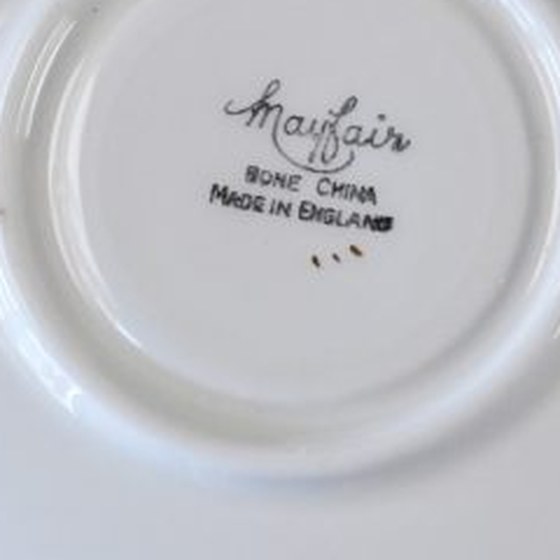
“Mayfair” in cursive — “Bone China / Made in England”A cursive Mayfair bone-china mark from the shop
Mayfair was a Staffordshire bone-china trade name of the 1950s–60s, making bright, pretty teaware for the mass market.
“Bone China / Made in England” with the cursive “Mayfair” points to the 1950s–60s.
An “Ht” code is a pattern number, not a date.
Ad
Adams
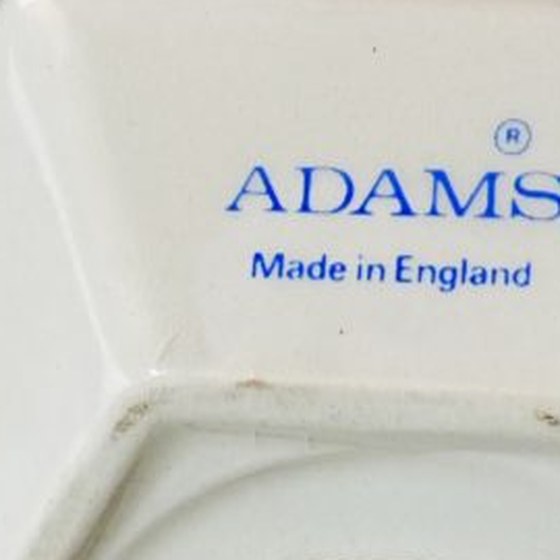
“Adams ® / Made in England”An Adams “Made in England” mark from the shop
William Adams & Sons of Stoke, one of the oldest Staffordshire names, made commemoratives and transferware. Later marks carry the registered ® symbol.
The ® registered symbol points to the later 20th century.
A dated commemorative subject (here the 1977 Silver Jubilee) dates the piece directly.
Mw
Midwinter
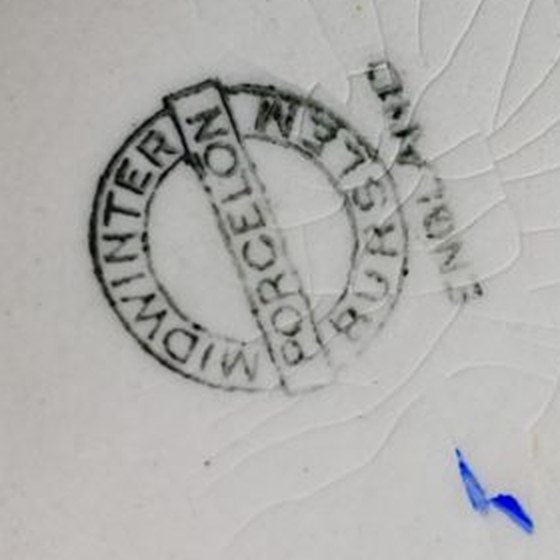
A circular mark — “Midwinter / Porcelon / Burslem / England”A Midwinter “Porcelon” mark from the shop
W.R. Midwinter of Burslem is famous for mid-century modern tableware, but earlier made commemoratives on its “Porcelon” body — as on this 1937 coronation mug.
“Porcelon” is Midwinter's body name, not a pattern.
An Edward VIII coronation subject dates it to 1936–37 (the planned May 1937 coronation, before the abdication).
NW
Nelson Ware — Elijah Cotton
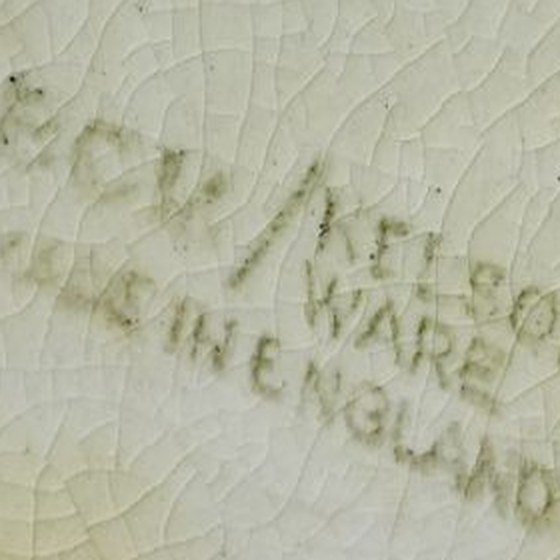
“E.C. / Nelson Ware / Made in England”An E.C. “Nelson Ware” mark from the shop
“Nelson Ware” was the trade name of Elijah Cotton (E.C.) of Hanley, a maker of chintz and commemorative earthenware.
“E.C.” or “Elijah Cotton” with “Nelson Ware” identifies the maker.
An Edward VIII coronation subject dates it to 1936–37.
V
Victorian commemoratives
Often a registration mark or plain “England” — the maker frequently unnamed
Jubilee wares for Queen Victoria's Golden (1887) and Diamond (1897) Jubilees were made by many potteries, and are often marked only with a registration mark and “England.”
A diamond-shaped registration lozenge dates a design to 1842–1883; a “Rd No.” to 1884 onward.
“England” alone (from 1891) with a jubilee subject places a piece to 1887 or 1897.
Th
Thomas — Bavaria
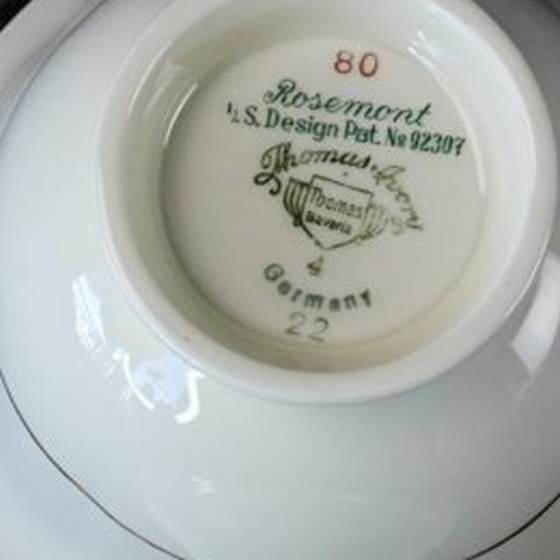
A lyre in a shield — “Thomas / Bavaria / Germany”A Thomas Bavaria lyre mark from the shop
Thomas was founded at Marktredwitz in Bavaria and became part of Rosenthal in 1908. The lyre-in-shield mark with “Thomas Bavaria” is its early-20th-century form.
“Bavaria” and “Germany” (not “W. Germany”) with a lyre mark suggest c.1908–1930s.
A “U.S. Design Pat.” number was for the American market and can be traced to a filing year.
Li
Limoges — France
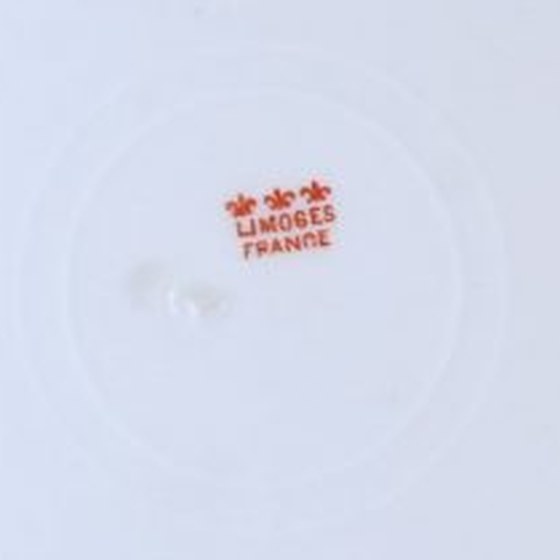
“Limoges / France” — often with a second whiteware maker's markA red “Limoges France” decorator's mark from the shop
“Limoges” names the French porcelain city, not one maker. Pieces often carry two marks: an underglaze maker's mark (here “Elite / France”) and an overglaze decorator's mark (“Limoges France”).
Two marks — one under, one over the glaze — mean a white-ware maker and a separate decorator.
“France” with “Elite” points to roughly 1900–1920s.
Me
Meissen
Crossed swords in underglaze blue — one of the oldest marks in the world
Meissen, the first true porcelain factory in Europe (Saxony, 1710), adopted its crossed swords in underglaze blue in the 1720s, and it has guarded the mark ever since.
Cancellation strokes ground through the swords mean the factory judged the piece a second; clean, uncancelled swords mean first quality (Erste Wahl).
An export word such as “Germany” (without “Made in”) points to roughly 1891–1918; an impressed model number names the subject. See our Meissen Golden Oriole journal for a worked example.
Jp
Japanese & Asian marks
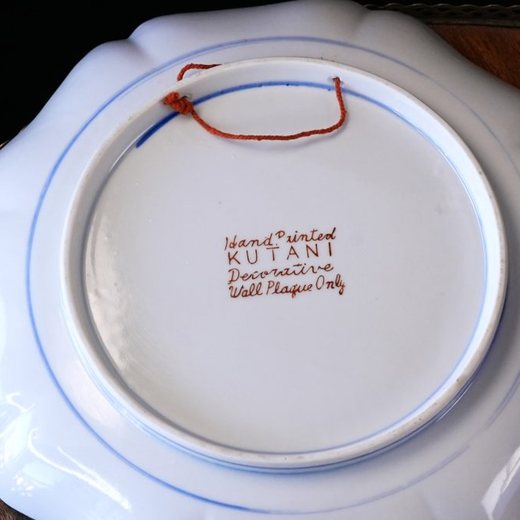
Hand-painted character marks — kiln names and auspicious phrasesA hand-painted Kutani-ware mark from the shop
Arita and Imari porcelain, Kutani ware and their cousins usually carry marks painted in red, gold or underglaze blue rather than printed. The characters may name a kiln, a studio or an auspicious phrase — and often are not a date at all.
Read the palette and potting as much as the mark: underglaze cobalt blue, the iron-red-and-gold Imari palette, hand-painted brushwork and foot-rim finish all help place a piece by style and period.
Signed studio and kiln pieces (for example Arita / Hizen wares) are attributed by mark, hand and decoration together.
Fg
Figurine & collectible makers
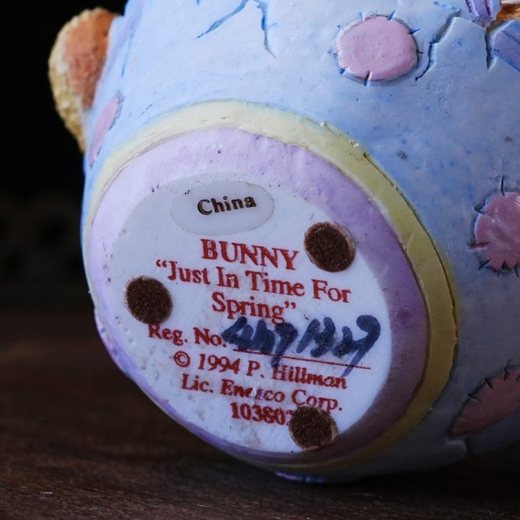
Printed or foil base marks, often with a model name and yearA collectible base mark (Cherished Teddies) from the shop
Sculptural and collectible figures carry their own conventions. Royal Doulton's HN numbers and Royal Worcester's modelled figures sit at the fine-art end; modern collectible lines are usually marked clearly on the base.
Cherished Teddies (Enesco), Boyds Bears and Fitz & Floyd typically carry a printed or foil mark with the line name, a model/style name and often a copyright year.
For unmarked studio pieces (Murano glass, some continental porcelain), attribution is by style, technique and form — which is exactly the sort of detective work we enjoy.
Ll
Lladró
Blue printed bellflower mark with “LLADRÓ”, usually over “HAND MADE IN SPAIN”
Lladró of Valencia marks its figures on the base or in the recess of the foot. The modern mark is a blue printed bellflower (bluebell) device with the name beneath it. Alongside it you will usually find an impressed model number and small workshop or decorator ciphers (letter–number pairs such as “F-5 D”) that record who worked the piece rather than when.
The blue printed mark with the wording “HAND MADE IN SPAIN” belongs to roughly 1977 onward; earlier pieces read “MADE IN SPAIN” or carry an impressed mark only.
The impressed number is the model, not a date — look it up to get the production window, then read the mark form to place the piece inside it.
A model whose production window has closed is a retired piece, which is where most of the collector premium sits.
Cherished Teddies were designed by Priscilla Hillman and produced under licence by Enesco. The base carries a printed plaque that is unusually informative — it normally gives the figure’s name, a copyright year, the designer credit, the licensee, and an item code (for example CT110).
The licensee wording changed over the line’s life — Enesco Corporation, Enesco Group Inc. and similar forms appear on different runs, so it is a useful rough sequence marker.
Club pieces add their own wording — charter-member seals and anniversary marks — which pins them to a specific club year.
PM
Precious Moments
Base mark with the Precious Moments name, designer credit and an annual production symbol
Precious Moments figures were drawn by Sam Butcher and produced under licence by Enesco. The teardrop-eyed children are made in bisque porcelain and marked on the base or the underside of the foot.
The line uses an annual production symbol — a small device changed each year — which is the quickest way to date a piece; the symbol is read against a published year chart rather than guessed.
An inscription title is usually moulded or printed with the figure, and helps identify the model.
As with Cherished Teddies, a copyright year on the base dates the design, not necessarily the casting.
Sw
Swarovski
Etched SC block logo (older) or the swan (from 1988)
Swarovski Silver Crystal figures carry a tiny etched mark, usually on a facet of the base or under the piece. The company changed the mark once, and that single change is the most useful dating tool on the object.
An etched “SC” block logo is the older mark, used roughly 1979–1988.
The swan replaced it from 1988 onward, and is often accompanied by a registration symbol.
These marks must be read in hand. They are etched into clear crystal, sit on a curved facet, and routinely fall outside the depth of field in a photograph — we have misread one ourselves from a photo and corrected it only under a loupe. If a listing dates a Swarovski piece from a photograph alone, treat the date as provisional.
JM
John Maddock & Sons
Crown-and-ribbon mark with “ROYAL IVORY” over “JOHN MADDOCK & SONS LTD”
John Maddock & Sons of Burslem, Staffordshire. The “Royal Ivory” body mark — a crown and ribbon device with the body name above the firm’s name — appears from about 1927, with small changes through the early 1930s. Pattern names (Minerva and others) and registered shape numbers are printed alongside.
A registered shape number dates the form’s registration, not the piece; a shape registered in the late 1920s stayed in production for years afterwards.
Watch the apostrophe. A mark reading “Maddock’s” (with the ’s) belongs to the American firm of that name, c. 1893–1915 — not to English Burslem. The two are regularly confused in listings.
RG
Royal Grafton
“Royal Grafton” with a crown, usually over “Bone China” / “England”
Royal Grafton was the trade name of A. B. Jones & Sons of Longton, Staffordshire. Both Grafton and Royal Grafton marks are found, the crowned form being the later of the two.
The wording “Bone China England” points to a 20th-century piece.
Pattern names and numbers printed with the mark are the main route to identifying a particular service.
CD
Royal Crown Derby
Printed crown over interlaced D’s, with a small date cipher beside the mark
The Royal Crown Derby mark reads “ROYAL CROWN DERBY” in an arc over a crown, above the firm’s interlaced D device with crossed batons and a ring of dots, with “ENGLAND” alongside. It is normally printed in a single colour — red on hand-painted wares of the late 19th century.
A small cipher beside the mark is the year code; Derby used a published sequence of symbols, so a dated piece can often be placed to the exact year.
“England” in the mark places a piece from 1891 onward; “Made in England” is later still.
Hand-painted pieces frequently carry a painted pattern number and a tiny personal mark from the decorator, written rather than printed.
Mo
Moorcroft
Impressed “Moorcroft” with a painted signature or initial
Moorcroft is art pottery, not factory ware — William Moorcroft trained as a designer, ran the Florian range at James Macintyre & Co., and set up on his own account in 1913. His son Walter Moorcroft took over on William’s death in 1945 and the pottery is still working today.
The decoration is tube-lined: the outlines are piped on by hand in slip, then the fields are filled with coloured glaze. Raised outlines you can feel with a fingertip are the signature of the technique.
Pieces normally carry an impressed factory mark together with a painted signature or initial; the painted element is the more useful of the two for dating, since it changed with the generation in charge.
Because it is studio work rather than mass production, even small pieces carry a collector premium.
T&
Tiffany & Co.
Stamped “TIFFANY & CO.” / “STERLING”, sometimes with a patent year
Tiffany flatware is stamped on the back of the handle. Three lines matter: the firm’s name, the standard, and — on some patterns — a patent year.
STERLING is the American standard, .925 silver, so the piece is priced as precious metal as well as for its maker.
On the Japanese pattern, a “PAT. 1871” stamp is the single most valuable line on the object. The pattern was introduced in 1871 (designed under Edward C. Moore, at the height of the Japonisme taste) and ran to about the early 1900s; it was reissued from 1956 as “Audubon”. The two look nearly identical, but only the 19th-century original carries the patent stamp — and the price difference between them is several fold.
Monograms are usual on period flatware and are not in themselves a fault.
No makers match that search — try a shorter word, or clear the box to see all 41.
Not sure what you're holding? Email a clear photo of the base — we're always glad to help read a mark.
A general reference compiled from standard ceramic-mark references and from the pieces in our own collection. Marks vary within every factory and were sometimes copied; we research and date each piece individually, and date ranges here are guides rather than guarantees.